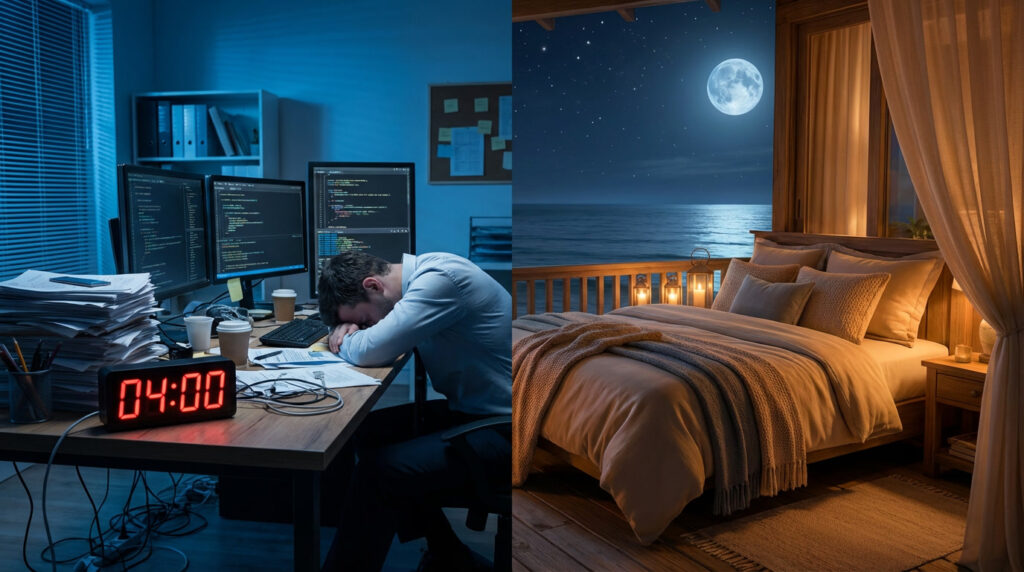
In today’s hyper-competitive world of modern business and leadership, we have been conditioned to view sleep as a luxury or a liability rather than an asset. We have been sold the myth of the “Sleepless Visionary”—the executive who survives on four hours of sleep and double espressos. In this culture, a 4:00 AM alarm clock feels like a badge of honour.
But here is the uncomfortable truth: your competitors aren’t outworking you; they are out-exhausting themselves into mediocrity.
In the high-stakes landscape of 2026, information is infinite, but clarity is a scarce commodity. If you are managing a global team, a nine-figure budget, or a disruptive startup, cutting your sleep isn’t a “hustle”—it’s a cognitive tax that is quietly bankrupting your judgment. While the “hustler” is busy making million-dollar decisions with the brain of a drunk, the CEO Sleeper is leveraging the 8th hour of rest as a lethal comparative advantage. Your most productive hour isn’t spent at your desk; it’s spent in your bedroom, where the real strategic edge is forged.
The Myth of the Sleepless Visionary
The glorification of the “all-nighter” is a 20th-century ghost that still haunts our 21st-century boardrooms. This myth was built on the back of 1980s “Greed is Good” corporate culture and later cemented by the tech-bro “move fast and break things” era. We were told that dominance required a relentless, machine-like output—a philosophy that treated the human brain like a hard drive that never needed to be powered down. But this “grindset” is a relic. It fails to account for the shift from a labour-based economy to a judgment-based economy. In a factory setting, staying an extra four hours might result in 20% more widgets. But as a leader, you aren’t paid for widgets; you are paid for the three or four high-leverage decisions you make each year. If those decisions are compromised because you’re chasing a “hustle” aesthetic, you aren’t being a visionary—you’re being a liability
.
The Biological Balance Sheet: The “Alcohol Equivalency” of Fatigue
In finance, every executive understands the danger of high-interest debt. Shorting your sleep is the same: it is a high-interest loan taken against your brain. You gain two extra hours of “hustle” tonight, but you pay for it tomorrow with a massive, invisible tax on your IQ.
Many CEOs would never dream of showing up to a board meeting after three drinks, yet they frequently show up in a state of sleep deprivation that is functionally identical. A seminal study published in Nature and Occupational and Environmental Medicine (Williamson and Feyer, 2000) demonstrated that after 17–19 hours of wakefulness, cognitive performance decreases to a level equivalent to a blood alcohol concentration (BAC) of 0.05%. After a longer period, that impairment reaches 0.1%—well above the legal driving limit. When you skip that final window of rest, you aren’t just “tired.” You are asking your brain to navigate complex corporate strategy while it is cognitively intoxicated. Further, every hour of lost sleep can lead to a 20% drop in cognitive performance, making those “extra” work hours counterproductive.
REM: The Executive’s Unpaid Consultant
Sleep is not a flat state of rest; it is a series of 90-minute cycles. While the first half of the night is dominated by physical recovery (NREM sleep), the second half—specifically the hours between six and eight—is heavily weighted towards REM (Rapid Eye Movement) sleep.
This final window is when the “CEO brain” does its most innovative work. According to research from Harvard Medical School, REM sleep enhances the brain’s ability to integrate un-associated information, creating the “Aha!” moments required for high-level problem-solving. By short-changing your sleep or waking up at the six-hour mark, you aren’t just losing 25% of your sleep; you are potentially losing up to 60-90% of your total REM cycle. You are effectively killing your creative edge and making yourself a “linear thinker” in a world that rewards non-linear breakthroughs.
The Interpersonal Edge: Empathy vs. The Hyper-Reactive Amygdala
Leadership is 90% people management. Your ability to remain calm under pressure and read social cues is your greatest interpersonal asset. Unfortunately, sleep deprivation directly erodes this. Research led by Dr. Matthew Walker at UC Berkeley found that the amygdala—the brain’s emotional “gas pedal”—is 60% more reactive in sleep-deprived individuals. Without adequate sleep, the prefrontal cortex (the “brake” of the brain) loses its connection to the amygdala. This results in “emotional irrationality,” where leaders misinterpret neutral feedback as threats and react with irritability rather than insight. Lack of sleep makes you more reactive and less empathetic—two traits that quickly kill company culture
Avoiding “Loss Aversion” in High-Stakes Decisions
Great leadership is defined by the quality of your decisions, not the quantity of hours you stayed awake. Fatigue mimics the effect of alcohol by rewiring how you perceive risk. A study in the journal Sleep by Killgore et al. (2006) discovered that sleep-deprived individuals lose the ability to integrate “affective feedback”—the gut feeling or nuanced data that warns us of a bad bet. This makes a leader more likely to engage in “risky” decision-making or, conversely, become paralyzed by “loss aversion” when a bold move is required. By short-changing your 8-hour window, you lose the sophisticated risk-assessment circuitry that separates a true CEO from a reckless gambler
Case Studies: The Elite “Sleepers”
To see the “CEO Sleeper” in action, look at those performing at the absolute pinnacle of their industries: Jeff Bezos: Frequently mentions that he prioritizes 8 hours of sleep to make high-quality decisions. He views himself as being paid to provide a small number of high-quality choices, not a high volume of low-quality work. LeBron James: Famously sleeps 10–12 hours a day for mental and physical recovery. He treats sleep as a competitive weapon. Arianna Huffington: Wrote The Sleep Revolution after collapsing from exhaustion. She now views sleep as a sacrosanct ritual for success. Roger Federer: Aims for 11–12 hours of sleep per night to maintain the sharp reflexes and mental stamina required for longevity.
The CEO Protocol: How to Protect Your 8-Hour Sleep
To transition from a “Sleep-Deprived Hustler” to an “Optimized CEO,” you must implement these data-backed protocols: The 3-2-1 Rule: Stop eating 3 hours before bed (to prevent digestive spikes), stop work 2 hours before bed, and eliminate blue screens 1 hour before sleep. The Digital Sunset: Turn off work notifications 90 minutes before bed. The Brain Dump: Write down tomorrow’s “top 3 tasks” before sleeping so your brain stops looping over them at 2:00 AM. Thermal Optimization: Your core temperature must drop to initiate deep sleep. Set your thermostat to 18°C (65°F). This helps trigger the body’s natural sleep signal. Strategic Supplementation: Consider Magnesium L-threonate, which research suggests crosses the blood-brain barrier effectively to promote relaxation.
The Bottom Line
In 2026, the “grind” is for those who haven’t figured out how to work smart. If you want to lead, disrupt, and win, you need to wake up to the truth: your 8 hours of sleep is not a luxury—it is the most powerful legal performance-enhancing drug in your arsenal. The “CEO Sleeper” isn’t lazy. They are simply better prepared for the battle
Charles Dennis
Sleep Investigator & Optimiser. I’m on a mission to disrupt the “hustle culture” myth and prove that elite performance starts in the bedroom, not the boardroom. I help high-achievers stop out-exhausting themselves and start leveraging sleep as their ultimate tool for high production and success. Join the mission below.


Leave a Reply